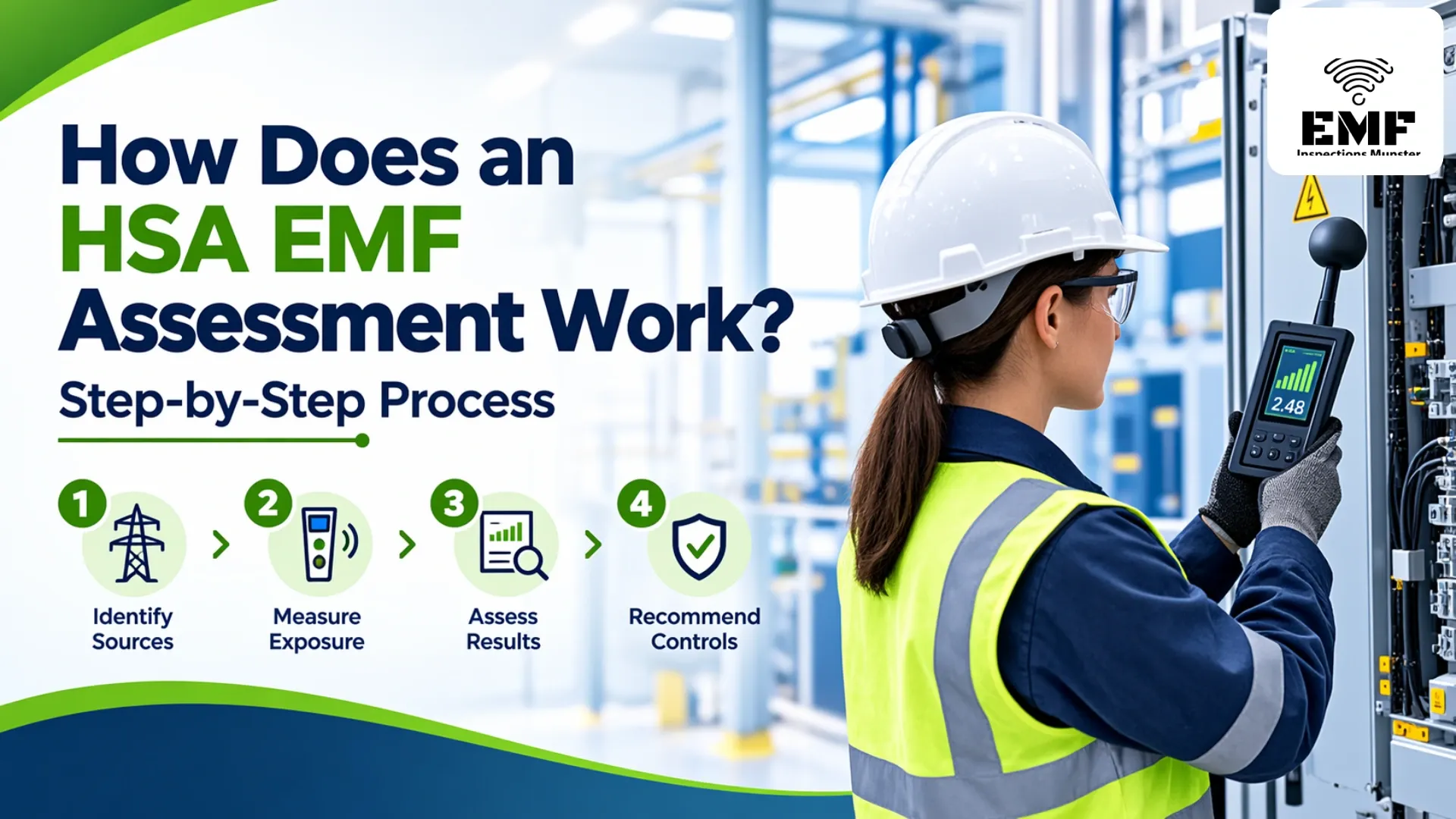
This process checks the electromagnetic fields (EMFs) your workers face and compares them with the limits that Irish rules require. A competent person identifies the sources, measures exposure, and records the results. The employer then fixes any problem areas and keeps the report on file.
Table of Contents
ToggleWhat Is an HSA EMF Assessment?
An HSA EMF assessment is a workplace review that follows the guidance of the Health and Safety Authority (HSA) in Ireland. The HSA is the national regulator for workplace safety. It enforces the rules on EMF exposure at work.
Here is an important point. The HSA does not issue an “EMF assessment certificate.” Employers must carry out the assessment themselves, or hire a qualified specialist to do it. The HSA can then inspect your records.
Why Does the HSA Care About EMFs?
Strong EMFs can affect the human body. They can cause nerve stimulation, dizziness, and heating of tissue. They can also interfere with pacemakers and other medical implants.
Irish rules follow EU Directive 2013/35/EU. It sets exposure limits and requires employers to assess the risk.
Benefits of a Proper EMF Review
Here is what you gain.
1. Legal compliance.
You meet your duty as an employer. You also hold written proof if an inspector asks.
2. Safer staff.
The review shows where exposure runs highest. You can protect workers before harm occurs.
3. Protection for vulnerable workers.
People with pacemakers, implants, or pregnancy need lower exposure. The review highlights these cases early.
4. Fewer equipment problems.
Strong fields can disrupt sensitive devices. Finding the cause prevents costly downtime.
5. Clear action steps.
You receive practical fixes, such as barriers, signs, access limits, and revised work methods.
6. Stronger safety culture.
Staff trust employers who act on risks and share the results.
How the Process Works, Step by Step
Every workplace is different. Most reviews follow the same eight steps.
Step 1: Define the scope.
The assessor learns about your site, your equipment, and the tasks your staff perform.
Step 2: List all EMF sources.
They note every machine, cable, transmitter, and device that produces fields. Examples include welders, induction heaters, MRI scanners, and radio equipment.
Step 3: Gather existing data.
Manufacturer manuals often list emission levels. This data saves time and guides the testing plan.
Step 4: Measure or calculate exposure.
Engineers use calibrated meters at the places where people actually work. For complex setups, they use computer models. A solid HSA EMF assessment depends on accurate readings at this stage.
Step 5: Compare results with the limits.
The team checks each reading against the exposure limit values and action levels. These cover both health effects and sensory effects.
Step 6: Review workers at special risk.
Staff with medical implants, and pregnant workers, have lower safe levels. The assessor checks these cases on their own.
Step 7: Write the report.
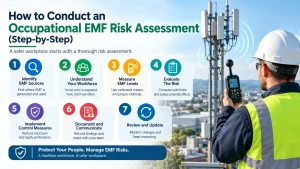
The report lists methods, readings, findings, and a risk rating for each area. This forms part of your wider Occupational EMF Risk Assessment record.
Step 8: Apply controls and review.
You put the advice into action. The assessor can retest if needed. Repeat the review after any major equipment change.
Cost Details
Prices vary with site size, equipment, and the depth of testing. These figures are general estimates only.
- Small office or low-risk workplace: about EUR 400 to EUR 900
- Standard industrial or healthcare site: about EUR 900 to EUR 2,500
- Large or high-power site with modelling: EUR 2,500 to EUR 6,000 or more
What Affects the Price?
- Number and type of EMF sources
- Size of the site and number of work areas
- Need for measurements, modelling, or both
- Special risk groups among staff
- Report detail and follow-up visits
A full Occupational EMF Risk Assessment costs more than a basic screening, but it gives you stronger protection. Always ask for a written quote. Confirm what it includes before you agree.
Who Is It Best For?
This service suits many Irish employers, including:
- Manufacturing and engineering companies
- Hospitals, clinics, and MRI units
- Telecom and broadcast operators
- Power and utility companies
- Welding and metalworking businesses
- Any employer with staff who use pacemakers or implants
Conclusion
An EMF review follows a simple path. Find the sources, measure the fields, check them against the limits, and act on the results. You end up with a safer workplace and a clear record that satisfies the regulator.
Do not wait for an incident or an inspection. Speak with a qualified specialist and get your workplace checked. Contact us today to book your assessment and receive a clear, practical report.
FAQs
1. Does the HSA carry out the assessment?
No. The employer is responsible. Most employers hire a qualified EMF specialist. The HSA enforces the rules and can inspect your records.
2. Is an EMF assessment a legal requirement in Ireland?
Yes. Irish rules, based on EU Directive 2013/35/EU, require employers to assess EMF risks at work.
3. How long does it take?
A small site usually takes one to two days, including the report. Large industrial sites take longer.
4. What equipment gets measured?
Welders, induction heaters, power cables, transmitters, MRI scanners, and other electrical equipment near workers.
5. What happens if levels exceed the limits?
You must reduce exposure. Common fixes include shielding, barriers, access limits, and changes to work methods.
6. How often should I repeat the assessment?
Repeat it after new equipment, layout changes, or high readings. Many employers also review it every few years.
Need expert help with your workplace? Contact us today for a clear quote.